Amazon.com: Dollars & Sense: The Definitive Guide to Self-publishing Success eBook: Carolyn McCray, Amber Scott, Rachel Thompson: Kindle Store.
Monday, February 6, 2012

Saturday, February 4, 2012
Persistence: Another four-letter word that isn’t
I ran across this quote a few days ago: The art of love … is largely in the art of persistence. Albert Ellis said it. And it is sticking in my mind, sticking to it in much the same way oatmeal sticks to your ribs. At first I thought of writing, how it is an act of love and how persistence is such a huge part of that love. I remember, vividly, painfully, the first time I was invited to join a critique group. They asked that I come to the meeting with a sample of my writing that I would be prepared to read out loud, in front of strangers. I worked hard and managed to produce one page of the novel I had in mind to write, that I thought might be fit to read, but when my turn came, my voice faltered. My mouth was so dry. I can’t imagine how I got through the ordeal. It was worse than the public speaking class I took in college where I was the only girl student in a roomful of guys. Who would want to endure that experience again? Much less week after week? Yet I did. I went back to the critique group and over time, I learned the craft of writing—through persistence. Was it me or was it the love for the art form, for the work itself, in me?
Then I extrapolated … what of my love for my children? How much of loving them was/is persistence? The moment they were settled into my arms after birth, I melted. I thought my heart would explode, I was in such awe, but then there were days. You know the ones. Those tests of love days. I would think: I am going to lose it here! I would go into the bathroom, shut the door and sit on the closed toilet lid and I would talk myself down, return to the fray, mete out whatever discipline was required. When everyone was calm again, we talked about what happened. It was an act of love, but wasn’t it also an act of persistence?
You fight with your spouse, you walk away and come back, talk it out. Isn’t that persistence? Love is like a visitor knocking on your door, persistently knocking until you open it and allow in the flood of inspiration, revelation, joy … the treasure that is there, that is inside you. We recognize that in each other and we persist in every way we can to connect with each other. We persist in loving one another, and our work, if we’re fortunate in that regard and often it is in the face of what seem to be insurmountable odds.
 Oh, that single page of that novel?—the one I persisted through huge resistance to write? It’s titled The Last Innocent Hour and it’s free for one more day, today. I’d love it if you’d download it … read that first page, imagine a mouse squeaking out the words. I’m sure that’s how I sounded!
Then I extrapolated … what of my love for my children? How much of loving them was/is persistence? The moment they were settled into my arms after birth, I melted. I thought my heart would explode, I was in such awe, but then there were days. You know the ones. Those tests of love days. I would think: I am going to lose it here! I would go into the bathroom, shut the door and sit on the closed toilet lid and I would talk myself down, return to the fray, mete out whatever discipline was required. When everyone was calm again, we talked about what happened. It was an act of love, but wasn’t it also an act of persistence?
You fight with your spouse, you walk away and come back, talk it out. Isn’t that persistence? Love is like a visitor knocking on your door, persistently knocking until you open it and allow in the flood of inspiration, revelation, joy … the treasure that is there, that is inside you. We recognize that in each other and we persist in every way we can to connect with each other. We persist in loving one another, and our work, if we’re fortunate in that regard and often it is in the face of what seem to be insurmountable odds.
Oh, that single page of that novel?—the one I persisted through huge resistance to write? It’s titled The Last Innocent Hour and it’s free for one more day, today. I’d love it if you’d download it … read that first page, imagine a mouse squeaking out the words. I’m sure that’s how I sounded!Wednesday, January 18, 2012
Read, Don't Wear Your (Kindle Nation Daily) Shorts!
 Kindle Nation Daily, (website link), the brainchild of Stephen Windwalker, Windwalker Media, is a webzine/newsletter about all things Kindle, and so much more, offering readers free book alerts, cogent indie-related articles and Kindle news, plus tips and tricks for getting the most out of your Kindle experience. It is no accident that it is the most popular Kindle community on the web. In addition to their Facebook page, which daily showcases a plethora of e-books for all tastes--from thrillers to romance to literary and historical, just every genre you can imagine--and all budgets, the webzine also sends out daily email blasts called Kindle Shorts. Not the kind you wear but the kind you read! In addition to an author biography and bits of other data, each short contains a generous excerpted serving of the book, usually the opening chapters, enough certainly to decide whether the work is to your taste. For readers it’s a great way to discover new authors without spending a dime. And today the featured short is an excerpt from my novel, The Volunteer.
Briefly, the story centers on psychologist Sophia Wilmot who through a haunting sequence of events finds
 herself holding the power to save death row inmate Jarrett Capshaw from execution. Sophia resists becoming involved, and wouldn’t have, if it were not for Jarrett’s wife and children. It’s his family and their struggle to survive, to come to terms with this calamity, that she can’t resist. But families are what The Volunteer is about, how they’re made and how in one single, horrifying instant, they can be broken. It is a story about mothers and the lies they tell to protect their children, to keep them from being hurt. But what happens when the truth comes out anyway and nothing and no one is spared? Sometimes the truth has the power to break your heart, and in Sophia’s case it will also endanger her freedom and threaten everything she has ever believed about her life.
I hope you will be intrigued by this short enough to check out and subscribe to the Kindle Nation Daily so you can sign up to receive the Shorts via email for yourself. I guarantee you will find authors and genres you love. And do visit their Facebook page, as well, to discover even more great new books every day. As an author myself I can’t say enough good about the variety of ways there are through this outlet to promote e-books. For me, the marketing end of this venture has been the most daunting and confusing. I didn’t even know where to start and when I found the Kindle Nation Daily website, I was thrilled. There it was, a variety of marketing plans laid out in a straightforward, creative and professional manner that from experience I know delivers fantastic, track-able results. Marketing a book, or any product, I think, is a cumulative adventure. It builds from each effort and having a plan is key. Having Steve’s support and the choice of the many venues he provides has been invaluable to me. Other authors agree. Read what they have to say here. All I can do is add my thanks and appreciation to theirs.
Sunday, January 15, 2012
Balancing Is Not an Act!
 Yesterday I attended a chapter meeting of the West Houston RWA. I’m not a member but tagged along at the invitation of two of my critique partners, authors Colleen Thompson and TJ Bennett, who were kind enough to include me. I had a special reason for going to this meeting, and it was because Joan Reeves, super-successful author of many super-fun and sexy romantic titles was the speaker. I had met Joan before, virtually, last summer through her Slingwords blog that I was led to from uber-successful Joe Konrath’s blog. I was in fact-gathering mode at the time, trying to absorb all I could about how to indie publish my work. To say I was naïve would be an understatement and finding Joe Konrath and then through his blog to be led to Joan’s Slingwords blog was just a gift. Without the support of the wealth of information they (and their followers) share, and the guidance Joan has so generously provided to me through our email correspondence, the learning curve would have been a lot sharper and more painful!
I went to that meeting feeling overwhelmed. It’s nothing new. I’ve been plagued with this sense ever since my first novel went live last August. I’m haunted by the notion that I am never going to master the skills necessary to keep all the multiple plates—actual writing + the process involved in artfully showcasing via cover, cover verbiage, endorsements etc. + formatting + marketing, which entails all the various social networking venues (also requiring of a cogent framework) spinning and maintain my balance. If I can ever even learn mastery of these skills—how best to use the tools that are available—that’s another question.
But two things I came away with yesterday…
One: I am not alone. Everyone involved in this new publishing world feels overwhelmed to some degree. (It isn’t just me being totally dense after all! At least not all the way!) Joan talked about how the indie landscape is changing, and not just yearly, but weekly, even daily! Back when I was a flight attendant I had a supervisor who gave me a piece of advice in reference to running (literally!) a four-course dinner service on a short flight. I’ve never forgotten it and it applies here: Do what you can do, and what you can’t do, don’t, and don’t worry about it!
The second thing...
Don’t waste your time doing anything that does not resonate with your soul no matter who tries to tell you otherwise. Follow your own inner guide, your own sense of what works for you. You don’t have to explain or apologize. Your way is your way, and it is to be honored and respected, revered even. You don’t have to be proficient at every level of social networking, or what-have-you, regardless of what form it takes. You only have to be true to yourself, and I believe when you are, bit by bit, the bridge to your goal, whatever it might be, is built. There is no magic bullet, no guarantee or sure-fire formula for success other than the magical, sure-fire way you create for yourself.
And Last...
Where are my manners? Thank you to everyone yesterday at the West Houston meeting. It was lovely. I enjoyed meeting everyone and got so much out of the discussion plus came home with two great reads!
Tuesday, December 27, 2011
The Last Innocent Hour is part of WLC's Year of the Indie Event!

The Last Innocent Hour, originally published in trade paper is now available for e-readers. It tells the story of Beth Cunningham who at eighteen was forced to leave the Texas farm where she was raised in order to escape her stepfather’s unwanted attention. She marries, but seven years later when her husband Charlie’s freewheeling gambling lifestyle jeopardizes their daughter Chrissy’s wellbeing, Beth sees no alternative other than to bring her family back to Texas. Beth’s mama has promised Beth’s stepfather is gone; Beth believes the nightmare that drove her from home—the one Charlie knows nothing about—is over. She believes her family will be safe. But within a matter of hours after their arrival, short innocent hours, a fresh storm, brutal and fearsome in its intensity, breaks. Charlie vanishes. Beth witnesses a murder, and with Chrissy in her arms, she’s running again. Running for her life. Too late, a voice whispers in her brain. Bang, bang you're next, taunts the voice behind her. And still she runs. Runs until she is falling. Runs until all reason is lost.
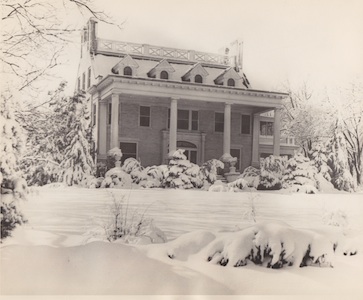
[caption id="attachment_598" align="alignright" width="300" caption="The "Big House" in winter - Beautiful!"]
 [/caption]
The house Beth flees, the one that’s pictured on the front cover of The Last Innocent Hour, was built by my great grandfather Horace Rogers for his wife, my beautiful great grandmother, Stella Williams Rogers, in the town of Fort Smith, Arkansas. My grandmother and her two brothers were raised in the house. Family legend has it that Stella chose the site, that her heart was set on it, but the parcel of land belonged to the estate of a deceased Arkansas governor and my great grandfather had a time talking his way into the purchase of it. The house is beautifully situated on a gentle rise with grounds that drop away like a full lowering skirt. It unfortunately has passed from the family years ago and the way that it did is a story all in itself.
The seed for The Last Innocent Hour was planted when I was attending college in Fort Smith one semester and my mother arranged with the (then) owner of the house for us to come and have a tour. I was in awe from the moment I walked onto the veranda. The front door opens into an elegant foyer, tiled in yards of marble. Doorways open from the foyer into a variety of rooms, music room, parlor, a library. The kitchen and a glass conservatory are at the back of the house, behind the stairs. But what drew my eye that day was the staircase. It was so wide and sweeping, with beautifully carved newel posts, and led up to a generously proportioned second floor landing, where a tall beveled and stained glass window rose from the floor like a crown. Light spilled through it silvering the air. The effect was magical. I guess that’s why out of all the other beautiful details there were to see that day, it is the window over the stairway landing that I remember most vividly. I describe it in the novel, how it frames the glare of lightening, how the rain runs like tears down the glass.
I think my sister Susan and I are the only great grandchildren to see the interior of that house. My one regret is that due to an illness in the owner’s family, my mom and I could not tour the third floor ballroom or go out on the widow’s walk. Someday I would like to go back there. Last I knew “the big house”, as it is affectionately referred to in the family, was a bed and breakfast. I’ve mentioned to my siblings and cousins that we should hold a reunion there, walk the halls and rooms of our ancestors. Maybe one day we’ll do that!
 Year of the Indie Event!
This week, December 24th through December 31st, The Last Innocent Hour, among many other great e-books, is being featured in The Women’s Literary Café’s Year of the Indie Event.
About the WoMen’s Literary Café
The WoMen’s Literary Café (welcoming both men and women) is an extension of The Women’s Nest. This Internet hub bridges the gap between writers and readers with the sole mission of promoting great literature. The WLC provides free marketing services allowing authors to connect with readers, reviewers, and the media, through numerous promotions and a launch platform for new books. The WoMen’s Literary Café is ‘Where readers and authors unite!’ I encourage you to visit Women's Literary Cafe to learn more.
Melissa Foster, the founder of WLC, and also of The Women’s Nest, an online community for women, which connects women across the world, is also a very fine author. I don't know how she manages everything that she does, but I'm glad for her support and the support of the writing communities she has worked so tirelessly to create. For more about Melissa, visit her website at www.MelissaFoster.com
Saturday, December 24, 2011
BUY THIS BOOK: Coping With Transition: Men, Motherhood, Money and Magic
 Transitions. Everyone goes through them, but even when they lead to something wonderful like marriage to the one you love or the welcomed birth of a child, they can be unsettling. Coping With Transition, Men, Motherhood, Money and Magic, edited by Susan Briggs Wright, is a memorable collection of memoirs from women who were born between 1935 and 1960. It was a pivotal era for women, a time when transitions, especially difficult ones, were seldom discussed. Women’s lives, family life, life in general was supposed to resemble the images Norman Rockwell captured on the pretty and serene covers he did for the Saturday Evening Post. The reality was often far different. Messier. Confusing.
Rules were numerous. Young women were cautioned to adhere to certain standards. “My father was strict about who I could go out with,” relates Suzanne Kerr in her memoir titled, Waiting For Marriage, Sex, and My Mother’s Life (In That Order). Suzanne’s dad went on to tell her as she was leaving the nest for college in September of 1962, that if he ever heard of her going to a boy’s apartment, he’d jerk her out of school. (Can you imagine handing down such a mandate to your daughter today?!) Her mother said she should marry a professional man, and oh yes, she should certainly be a virgin. Suzanne chronicles what becomes a long and circuitous path to the altar in a voice that mixes elements of wry humor and rueful irony. And honesty. It’s the honesty and trueness of each voice in the collection that makes it such a compelling read.
Why do I not remember days, only moments? How do I start … with the end of my life? So begins Sue Jacobson’s haunting memoir, Why Have I Survived You? in which she tells of the loss of a beloved daughter. Donna Siegel begins her memoir, Crossing the Rubicon, with this notable line: Growing into who you are genetically destined to be can cause a lot of problems. Donna was married at 19 and divorced after a lifetime. Somewhere she found the courage to reenter school, to earn her master’s degree, but even better, she lives comfortably now with life’s questions, its mystery. In A Closet: Memories, Meaning, and Sometimes Magic, Mel Gallagher, confides that her closet (of all curious and imaginative places!) and all that it contains has given her insights into her life. Leslie McManis begins her short essay, Growing Up Outside, with this intriguing line: My mother was a forties beauty queen, and then renders the poignant details of an injured childhood, but the accent is on survivorship, not victimhood. What touches a chord throughout this collection is the amount of courage and resilience that was and is still demonstrated by this remarkable group of women. The collection is diverse, covering topics from a husband’s impending retirement to the pursuit of international adoption—at the age of forty-nine, no less. Talk about courage. And there’s long, intimate and wise talk about seizing love and the moment—at sixty-eight from Mary Margaret Hansen. No, she isn’t thirty-five, but she’s still very full of life with so much to do, to share and contribute as you will find out when you read her witty and smart memoir Seven Scenes From Shared Space.
Coping With Transition, Men, Motherhood, Money and Magic is truly a book for women of all ages, and the men who want to understand them—who dare to try! Reading it is like sitting down to have an intimate chat with dear friends and the conversation is one that leaves you feeling satisfied and hopeful. It’s life affirming. It would be great to see this collection digitized for e-readers. It’s perfect for reading on the go. A perfect delight all the way around.
Wednesday, December 7, 2011
Should we kill a killer if he wants to die?
[caption id="attachment_485" align="alignright" width="300" caption="Click the image to hear a judge explain the legal logic for granting Haugen's wish"]
 [/caption]
Last month, Oregon Governor, John Kitzhaber, imposed a moratorium on the death penalty for the remainder of his term, saying he's morally opposed to capital punishment and has long regrettedallowing two men to be executed in the 1990s. Oregon is the fifth state since 2007 to halt the execution process. One of the biggest motivating factors behind this decision is the fear of killing the wrong person. It happens and often the tragedy isn’t uncovered until after the fact. After lives and families are destroyed.
But what about the inmates who ask to die? The death row volunteers who are guilty by their own admission. So guilty there is not so much as the sliver of a shadow of doubt. That’s the case with twice-convicted murderer Gary Haugen. After serving thirty years in prison, the last several on Oregon’s death row, Haugen asked the same legal system that handed down his death sentence to carry it out. A judge agreed, and Haugen’s execution date was scheduled for December 6th.
But it didn’t happen because Oregon’s governor suffered a moral crisis over the issue and shut down the death machine. Until his term is over, he says. Then the next governor can sort out the legislative mess.
Some objectors say volunteering is a way for inmates to control the system. Some say it’s state-assisted suicide. Some would take every death row inmate, including Haugen, “out back” and shoot them. Others think sitting out your days in a prison cell is a worse penalty, a living hell as opposed to the eternal one that may wait after death. But however you look at it, volunteers are in a different category. They aren’t straining the already burdened courts with yet one more appeal beyond asking to die. Now. They aren’t looking for a loophole or pleading they’ve been saved by Jesus Christ, although professionals in the field say, as in the case of Haugen, such petitions are often meant to draw attention to the flaws in the justice system. But even if legal reform were to occur as a result of their actions, volunteers must know they won’t be alive to see it.
So, what’s the real point? In research for my novel, The Volunteer, I read a lot of interviews of these inmates, and while many had strong opinions about the whole emotionally-charged, Gordian Knot that surrounds the death penalty, at their core, what some of them seemed to feel was the need to take responsibility. Short of returning to life those who were dead by their hands, it was all they could do. End the suffering of their victim’s families, and in some cases, of their own families. And isn’t this, at least in part, the logic that underlies the death penalty? That the suffering should come to an end?
So while I can admire Kitzhaber for his courage in standing up for his convictions, and for doing so under a barrage of public criticism, while I even share in his moral confusion about the matter, I think an exception should be made for Haugen, and in the case of all volunteers like him. Let the ones who choose to shoulder the terrible burden of their crimes go. Let it be over. Let Haugen fulfill his court-ordered obligation, the one a judge and jury, showing no less courage than Kitzhaber in making their decision to send Haugen to his death, says he deserves. And let those who are left behind find peace . . . if they can.
Subscribe to:
Posts (Atom)